I found a few of my philosophy papers from first year University today and thought I'd share my favourite bit of one.
First though, I am going to speak of the teacher who taught my class. He was at my school for a total of one semester, then he got a better gig at U of T and buggered off. He was, bar none, the quirkiest dresser I have ever seen. Tall, bald, and bespeckled, and then also adorned in tapered pants with various loud and outrageous shirts. For example: pink with pinapples all over it, one with dancing fruit on it, a zut suit he'd painted with monet like impressions on the front and back panels...the list goes on. He would get us, at the beginning of most classes and without any idea as to why, to start listing things like "mythical creatures" or "emotions" or something really abstract, and then somehow bring it around to make perfect sense with whatever incredibly complex and ancient philosophy we might be learning that day.
So this little excerpt is basically my thoughts in response to George Berkeley's Three Dialogues between Hylas and Philonous, and his theory that "sensible qualities are not inherent in matter, rather they are ascribed and understood by the mind. Color, sound, temperature, even shape, are relative qualities entirely dependent on a mind. Indeed without a "mind" it becomes impossible to imagine matter."
And so it begins...
Though I cannot agree with Berkeley's arguments that all things are dependant on the mind to exist, that materialism is a fallacy and that God is sustaining all the sensible qualities that I do not perceive directly, I have often wondered how different people's perceptions alter reality. How can it be confirmed that what I see to be the colour orange is what the next person perceives as the same colour. Perhaps what I see as orange, they are seeing as green, and perhaps what they see as green I see as the same colour but call it by another name. Does colour even exist in the absence of light? Just because we cannot perceive the qualities that a particular object contains, whether sustained by the mind or not, does not mean that it does not contain those qualities. Were we to believe that everything exists for the sake of the mind, then what exists beyond what we perceive? Is there nothing at all until we perceive it? In that regard I must believe that individual objects contain their own qualities, if only to avoid thinking that there is a great abyss just beyond my perception that must be sustained by some other force that I cannot perceive and know to be real.Chuck that in your pipe and smoke it!
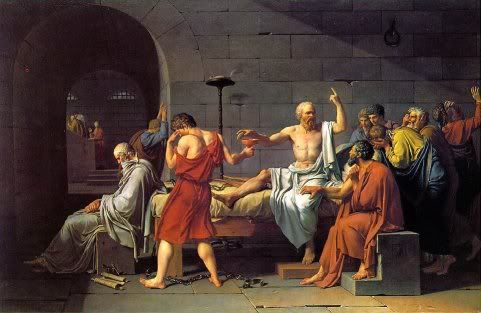
Also, the above picture is "The Death of Socrates" by Jaques-Louis David, one of my faaaaaavourite artists.

No comments:
Post a Comment